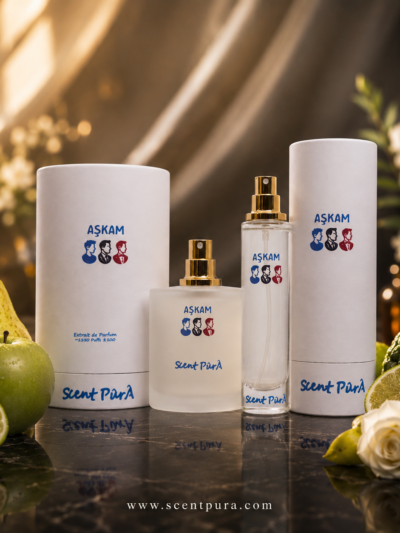
Aşkam
Fresh fruity floral fragrance with bergamot, pear, and green apple, blended with jasmine, rose
100 ml
40 ml
fromRs 2,699Rs 2,800
Choose size 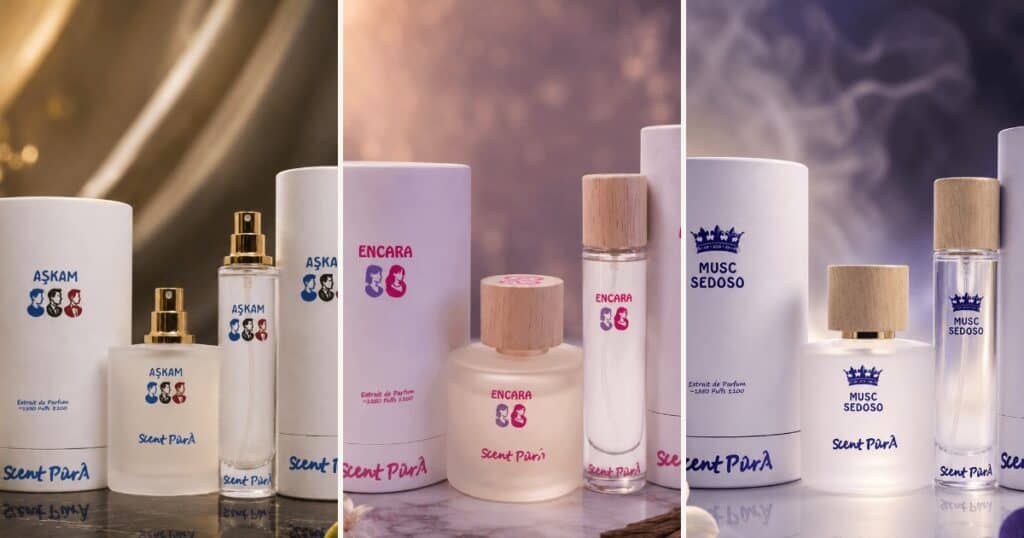
If you have ever sprayed a fragrance in the morning only to catch nothing but skin by the time you leave the office, you already know the problem. Lahore, Karachi and most of Pakistan run hot for a big chunk of the year, and heat is one of the fastest ways to burn through a perfume. The fix is not always a different perfume. Usually it is a different routine — and, occasionally, a different kind of perfume.
A fragrance is oil suspended in alcohol. The alcohol is a delivery system: it evaporates off your skin and carries the scent up with it. That is the whole mechanism, and heat accelerates every part of it.
At 40 °C the alcohol flashes off far faster than it would in a Murree winter, taking the light top notes — citrus, green notes, aldehydes — with it almost immediately. What you smell at 9am is not what the perfumer intended you to smell at 9am; it is the same opening played at double speed.
Sweat makes it worse in two ways. It physically washes oil off the skin, and it shifts your skin’s pH, which changes how some materials smell. A rose that reads clean and powdery in air conditioning can turn sharp and metallic on a humid afternoon in Karachi. Neither is a fault in the perfume.
And there is a third factor almost nobody accounts for: your skin is hotter, so it is projecting harder. A fragrance that seems to have vanished has often just spent itself in the first two hours instead of the first six.
Before any of the tricks below, understand the single biggest variable, because no application routine will rescue a fragrance that was never built to last.
Perfumes are sold at different oil concentrations, and the name on the box tells you which:
That last band is wide, and where a fragrance sits inside it matters more than the word on the box. Most things sold as extrait are near the bottom of the range. Ours are blended at 35–40%, which is the top of it.
Concentration is the part that matters most in heat. Less alcohol means less of the volatile carrier that heat attacks first. An extrait does not shout on the first spray the way an EDT does — which occasionally disappoints people in the shop — and then it is still there at 6pm when the EDT has been gone since lunch.
Everything we make is extrait de parfum, for exactly this reason. It is not a marketing tier; it is the concentration that survives a Pakistani summer.
Dry skin does not hold fragrance, and heat dries skin out. Oil clings to oil. An unscented, alcohol-free moisturiser on your pulse points thirty seconds before you spray gives the perfume something to hold on to, and it is the single cheapest improvement available to you. Plain petroleum jelly works if you have nothing else — a thin smear, not a layer.
Wrists, the sides of the neck, behind the ears, the inner elbows. These run warmer than the rest of you, which keeps the fragrance diffusing steadily rather than releasing all at once.
Clothes are not a mistake — fabric holds scent far longer than skin does, and a spray on a shirt collar or a dupatta will outlast anything on your wrist. But skin is where a fragrance develops and changes. Do both.
Rubbing your wrists together feels like the natural thing to do and it is the most common mistake in perfume. The friction generates heat and the pressure ruptures the top notes, so you crush the opening and speed up exactly the process you are trying to slow down. Spray, and leave it alone.
Over-spraying does not extend a fragrance. It burns off the same way, just more of it at once, and in a hot room it turns what you meant as a signature into something everyone in the lift has an opinion about. Two to three sprays is enough for an extrait. If you are used to an EDT, this will feel like too little for the first week.
Three places to avoid in this climate specifically:
This one costs people whole bottles, and it is specific to how most Pakistani homes are laid out.
A bathroom shelf is the worst place in the house for a perfume: hot, humid, and swinging thirty degrees every time somebody showers. A windowsill is nearly as bad — direct sun degrades the oils and will visibly darken a pale juice inside a season. A car glovebox in June is simply an oven.
Heat and light break down the molecules in the bottle, so a fragrance stored badly does not just fade faster on skin; it is a different, flatter, sourer fragrance before it ever reaches you. Keep bottles in their box, in a cupboard or a drawer, away from a window. That is the entire method, and it will add years.
Certain materials simply hold up better in heat. Amber, oud, resins, leather, musk and vanilla are heavy, low-volatility molecules — they evaporate slowly by nature, which is why they sit at the base of almost every long-wearing fragrance ever built. Citrus, green notes and light florals do the opposite.
That does not mean you have to wear oud in July. It means you want something anchoring the base, even under a fresh opening. A few from our own shelf, by what they are built on:
If you genuinely want fresh — and in July most people do — Istotny and Flor Clara are both aquatic, but built over wood rather than over nothing, which is the difference between a fresh fragrance and a short one.
Not sure which of those is you? A tester box is five fragrances for Rs. 1,500, and every full bottle ships with a matching tester anyway — so you can wear one for a week in real Pakistani weather before breaking the seal on the bottle. Reading about longevity is no substitute for a Tuesday in Lahore.
Skin type, mostly. Oily skin holds fragrance considerably longer than dry skin, and body temperature and pH vary between people enough to change both longevity and the smell itself. It is not in your head, and it is not the bottle.
On most fabrics, no. On silk and on anything pale, possibly — perfume oils can leave a mark, and darker juices can stain. Spray the inside of a collar or a hem rather than the front of a kameez, and never spray a silk dupatta directly.
A cool, dark cupboard is enough and carries none of the risks. A fridge is fine for long-term storage of something you rarely wear, but repeated cold-to-warm cycling is its own stress, and most kitchen fridges smell of food. The box in a drawer is the better answer.
Two to three. If people are commenting from across a room, it is more than two to three.
It changes rather than spoils. Stored properly, three to five years is ordinary and many go far longer. Stored on a sunny bathroom shelf, you may notice the top notes going sour inside a year — which is the whole argument for the cupboard.
Moisturise first. Spray pulse points and fabric, two or three sprays, and do not rub. Keep the bottle out of the sun and out of the bathroom. And if you have done all of that and a fragrance still leaves you by lunch, the problem is the concentration, not the technique — which is a solvable problem, and the reason everything we blend is extrait.
Extrait de parfum, blended in Pakistan. A tester in every box.
Fresh fruity floral fragrance with bergamot, pear, and green apple, blended with jasmine, rose
Elegant floral woody — lavender, bergamot, mandarin, rosewood
Soft floral musk perfume with notes of violet, jasmine, and vanilla
Sensual — apple, bergamot, neroli, rose, patchouli, vanilla, amber, musk