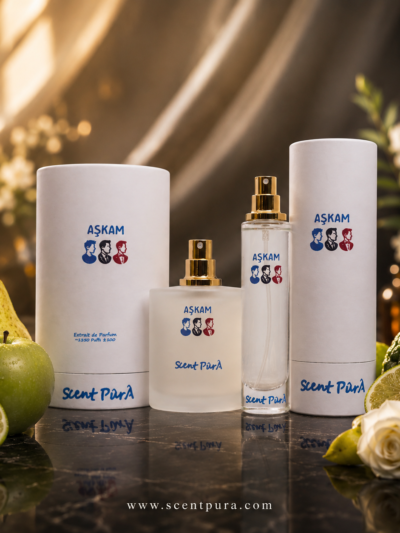
Aşkam
Fresh fruity floral fragrance with bergamot, pear, and green apple, blended with jasmine, rose
100 ml
40 ml
fromRs 2,699Rs 2,800
Choose size 
Two bottles, same name, same notes, and one costs noticeably more. The difference printed on the label is usually “eau de toilette” or “eau de parfum”, and most shop assistants explain it in a single word: “stronger”. That is roughly true, but it misses the part that matters in Pakistan: how each one behaves at 38°C, on a commute, eight hours later.
We sell perfume, and every bottle we sell is an extrait de parfum, which is stronger than both. So we have an interest here. We have tried to keep this guide useful whichever label you end up buying.
Every fragrance is a blend of aromatic oils diluted in alcohol (and sometimes a little water). The label tells you roughly how much oil is in the mix. There is no law that fixes these numbers, so treat them as typical ranges, not rules:
| Label | Typical oil content | Typical wear | What it feels like |
|---|---|---|---|
| Eau de cologne (EDC) | About 2–5% | 1–2 hours | A splash; refreshing, fades fast |
| Eau de toilette (EDT) | About 5–15% | 2–4 hours | Bright opening, lighter trail |
| Eau de parfum (EDP) | About 15–20% | 4–8 hours | Fuller, more of the heart and base |
| Extrait de parfum / parfum | About 20–40% | 8 hours and more | Dense, sits closer, lasts longest |
Wear times depend heavily on your skin, the weather and the notes themselves, which is the second half of the story.
Concentration sets how much perfume is there. The notes decide how fast it leaves. Citrus, mint and other fresh top notes are made of small, light molecules that evaporate quickly, whatever the concentration. Woods, amber, musk, vanilla and oud are heavy and slow.
That is why a fresh citrus EDT can be gone before lunch in Karachi, while an amber EDP can still be there at dinner. It is also why “EDP vs EDT” is only half a buying decision. A fresh scent in a stronger concentration will last longer than the same scent as an EDT, but it will never behave like an oud.
Heat speeds all of this up. Warm skin pushes perfume off faster, so it smells louder for the first hour and fades sooner. If you have ever wondered why your perfume does not last, a light concentration of a fresh scent, in summer, is the usual culprit.
Usually, yes, per bottle, because there is more oil in it. But the price on the label is a poor guide on its own, because bottle sizes vary so much. Price per ml is fairer, though it still does not account for concentration. These figures were checked on each brand’s own site (or the stockist named) on 29 October 2026:
| Perfume | Label | Size | Price | Per ml (approx.) |
|---|---|---|---|---|
| THE NOTE Citron | Extrait de parfum | 15 ml / 50 ml | Rs 1,649 / Rs 4,249 | Rs 110 / Rs 85 |
| J. Zarar Blu (via PerfumeDaddy) | Eau de parfum | 100 ml | Rs 5,200 | Rs 52 |
| J. Janan Platinum | Eau de parfum | 100 ml | Rs 6,900 | Rs 69 |
| Colish Queen of Hearts | Eau de parfum | 100 ml | Rs 7,800 | Rs 78 |
| J. Santal Noble | Extrait de parfum | 100 ml | Rs 16,000 | Rs 160 |
| Colish Anokha | Extrait de parfum | 100 ml | Rs 25,000 | Rs 250 |
| Scent Pûr Icy Brisk | Extrait de parfum (35–40% oil) | 40 ml / 100 ml | Rs 2,199 / Rs 4,799 | Rs 55 / Rs 48 |
Two honest readings of that table. First, J.’s eau de parfums are good value per ml, and you can smell them in a shop before buying. Second, the most expensive bottles here are extraits, but the cheapest per ml is also an extrait (ours). Price follows the brand and the bottle as much as the oil. For a fuller breakdown, see our 2026 guide to what perfume costs in Pakistan.
International designer EDTs are also sold widely in Pakistan, usually at several times these prices. If you love a particular designer scent, the EDT is often the cheaper way into it; just expect to reapply.
The concentration is usually printed on the front of the bottle or box, sometimes abbreviated: EDT, EDP, or “parfum” / “extrait”. Some brands also use their own terms, such as “intense” or “elixir”, which usually mean a stronger version of an existing scent but are not standard. If a label only says “perfume” or “fragrance”, it tells you nothing about strength; check the product page, or ask the brand what percentage of oil it uses. Few brands publish that number, which is one reason we state ours.
If you like fresh scents but hate how quickly they vanish, look for a fresh perfume built on a slower base. Some of ours, with the live prices for 40 ml and 100 ml:
And if you want the longest wear, the heavier bases do the work: Musc Sedoso (musk, vanilla and amber, 10–12 hours, Rs 2,999 / Rs 6,399) or Oud de Pura (oud, sandalwood, amber and vanilla, 10–12 hours, Rs 2,799 / Rs 5,599).
If you want to run that test across several perfumes without buying full bottles, our build-your-own tester box is 5 perfumes for Rs 1,500.
We only make extrait de parfum, at 35–40% oil, in 40 ml and 100 ml. That means we do not have a light EDT for people who prefer one, and on a cool day an extrait can feel like more than you need. What it does give you is more hours per spray, which is the problem most people in Pakistan are trying to solve. If you prefer the lightness of an EDT, buy an EDT; it is a perfectly good choice.
Usually, yes. An EDP typically has around 15–20% perfume oil against roughly 5–15% for an EDT, so it lasts longer and shows more of the base notes.
There is less oil, and EDTs are often built around fresh top notes that evaporate fastest. Heat makes both effects worse.
Per bottle of the same scent, usually. Across brands, price depends more on the brand and bottle than on the concentration, so compare price per ml.
If you want the scent to last a working day, an EDP or extrait. If you want something light for a few hours, an EDT is fine.
Extrait de parfum (sometimes just “parfum”), typically around 20–40% oil. It lasts longest and usually sits closer to the skin.
Apply to moisturised skin and to clothing, and keep the bottle out of heat and light. Our guide on applying perfume in Pakistan’s heat covers the details.
Extrait de parfum, blended in Pakistan. A tester in every box.
Fresh fruity floral fragrance with bergamot, pear, and green apple, blended with jasmine, rose
Herbal leather fragrance with bergamot, lavender and artemisia, tarragon
Elegant floral woody — lavender, bergamot, mandarin, rosewood
Soft floral musk perfume with notes of violet, jasmine, and vanilla