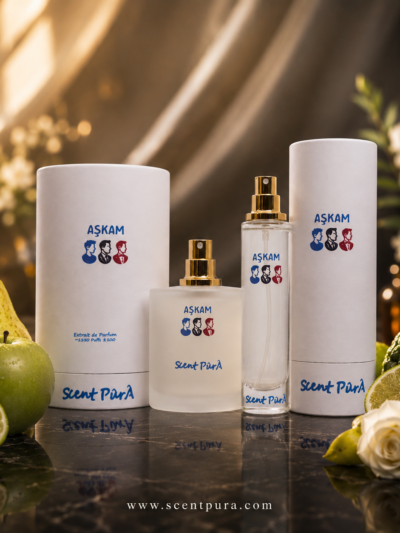
aşkam
Fresh fruity floral fragrance with bergamot, pear, and green apple, blended with jasmine, rose
100 ml
40 ml
fromRs 2,199Rs 2,700
Choose size 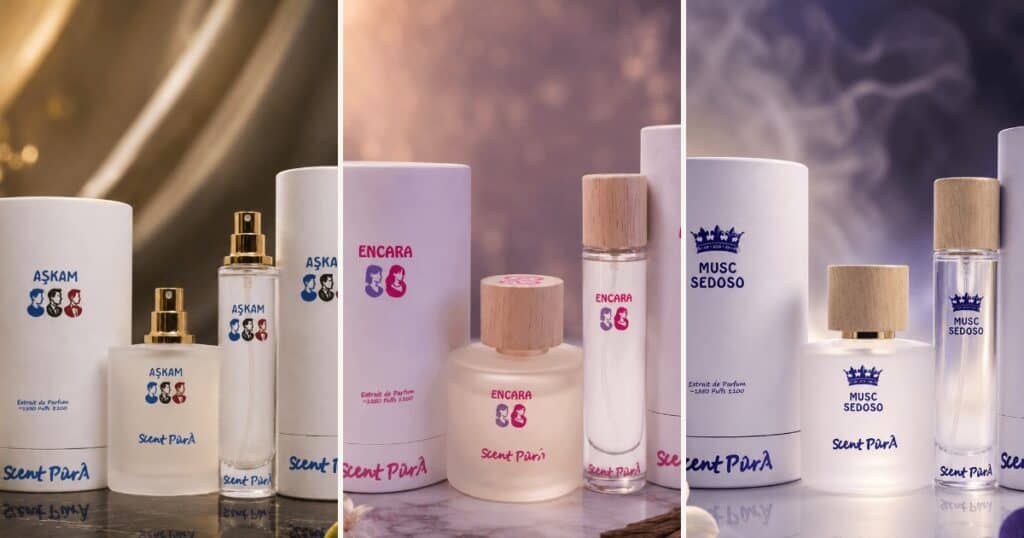
Ask what a perfume should cost in Pakistan and you get a number with no unit attached. Rs. 1,699. Rs. 25,000. Rs. 55,000. All three are real prices for real bottles sold in this country right now, and none of them tells you whether you are being looked after or taken for a ride.
This guide fixes that by doing one piece of arithmetic that almost nobody in Pakistani fragrance retail wants you to do.
Two things to say before we start. First, we sell perfume, so read this with the appropriate scepticism — everything below is checked against our competitors’ own public product pages, and we have linked them so you can verify any figure yourself. Second, we do not come out on top of every row, and we have not arranged it so that we do.
A perfume’s price tells you almost nothing. A perfume’s price per millilitre tells you nearly everything.
Here is why that distinction is not pedantic. THE NOTE sells an extrait called Citron at Rs. 1,649. Colish sells an extrait at Rs. 25,000. The Colish bottle costs fifteen times more, so it must be the extravagant one.
Except the Citron bottle holds 15 ml and the Colish bottle holds 100 ml. Divide:
The gap is not fifteen times. It is a little over two. The rest was bottle size doing the work that marketing usually gets credit for.
Small bottles are not a scam — they are a reasonable way to make an expensive thing affordable, and a 15 ml bottle you finish beats a 100 ml bottle you get bored of. But a small bottle makes a high per-millilitre price invisible, and that is worth knowing before you buy.
Every figure below was taken from the retailer’s website on 25 September 2026. Prices move, promotions come and go, so treat these as the shape of the market rather than today’s till receipt.
| What it is | Example | Bottle price | Per ml |
|---|---|---|---|
| “Master copy” of a designer scent | Sauvage 100 ml copy, UAE-made | Rs. 3,500 | Rs. 35 |
| Extrait, large bottle | Our Zerato 100 ml | Rs. 4,699 | Rs. 47 |
| Extrait, small bottle | Our Zerato 40 ml | Rs. 2,199 | Rs. 55 |
| Mass-market EDP, big bottle | J. Janan Platinum 200 ml | Rs. 12,000 | Rs. 60 |
| Mass-market EDP | J. Wasim Akram 502, 100 ml | Rs. 6,400 | Rs. 64 |
| Mass-market EDP, small bottle | J. Zarar 30 ml | Rs. 2,200 | Rs. 73 |
| Local niche EDP | Colish Queen of Hearts 100 ml | Rs. 7,800 | Rs. 78 |
| Local niche EDP, upper end | Colish Outcast 100 ml | Rs. 10,800 | Rs. 108 |
| Extrait, 15 ml format | THE NOTE Citron | Rs. 1,649 | Rs. 110 |
| Extrait, 15 ml format | THE NOTE Amber Leather | Rs. 1,839 | Rs. 123 |
| Extrait, upper end | Our Nobel Quest 40 ml | Rs. 5,199 | Rs. 130 |
| Premium local extrait | Colish extrait 100 ml | Rs. 25,000 | Rs. 250 |
| Traditional attar | J. Musk-e-Shaheer 12 ml | Rs. 3,080 | Rs. 257 |
| Authentic imported designer | Dior Sauvage EDP 100 ml | Rs. 55,000 | Rs. 550 |
Sources, so you can check: Colish, THE NOTE, J. Junaid Jamshed via PerfumeDaddy, The Perfume Club.
Three things jump out of that table, and only one of them flatters us.
Rs. 35 per ml for something wearing Dior’s bottle design is the lowest number in this guide. We are not going to pretend otherwise, because you can see it on any marketplace in five seconds and it would make everything else here less believable.
What you are buying at that price is an unregulated formulation with no stated concentration, made by a factory you cannot identify, in packaging designed to be mistaken for something else. It may smell close on the first spray. Nobody publishes what is in it, nobody stands behind it, and the words “same bottle like original” are doing a great deal of work.
If price per ml is your only criterion, the copies win and this guide is over. Most people have a second criterion.
Look at J. Their 30 ml Zarar is Rs. 73 per ml and their 200 ml Janan Platinum is Rs. 60 per ml — the same company, the same kind of product, an 18% difference driven purely by format. Every brand in this table does a version of that, including us: our 100 ml sizes work out roughly 8–15% cheaper per ml than our 40 ml, depending on the fragrance.
The practical rule: if you already know you like a fragrance, the big bottle is nearly always better value. If you do not, the small bottle is cheaper tuition.
This is the one that costs the industry money to admit, so it rarely gets said.
Extrait de parfum describes a range, not a point. The category runs from roughly 20% to 40% perfume oil, and a fragrance at the bottom of that band and one at the top are both entitled to the word. Nothing on a Pakistani box is required to tell you where inside the range it sits, and very few do.
So in the table above, four different products carry the word “extrait” at Rs. 47, Rs. 110, Rs. 130 and Rs. 250 per ml. Some of that spread is oil. Some is bottle, brand, retail rent and margin. Without a stated percentage you cannot tell which, and neither can we — we are not going to guess at anybody else’s formula.
What we can tell you is ours. Everything we blend sits at 35–40%, which is the top of the category band. That is the reason our per-ml figures look the way they do, and it is the only claim in this article we are asking you to take on trust rather than arithmetic.
Rough guidance, by what you are actually trying to do:
Across our best-selling fragrances, our bottles work out between Rs. 46 and Rs. 130 per ml depending on the fragrance and the size you choose. The entry of that range costs about the same per millilitre as a mass-market eau de parfum, for something blended at nearly twice the concentration. The upper end sits alongside other local niche houses.
We are not the cheapest perfume in Pakistan and we have just shown you what is. What we would argue is that Rs. 46 per ml for a 35–40% extrait is the most oil per rupee available from anyone who will tell you what is in the bottle.
You do not have to believe that. Every bottle we sell ships with a matching tester, and a tester box is five fragrances for Rs. 1,500 — which exists precisely because longevity is a claim about hour six and no price table can settle it. If you want the application side, we wrote up how to make a fragrance last in Pakistan’s heat.
For imported fragrance, a large share of the price is import duty and retail margin rather than the liquid — an authentic 100 ml designer bottle lands around Rs. 55,000 here. Locally made perfume avoids most of that, which is why a Pakistani extrait can cost a tenth of an imported eau de parfum per millilitre.
No. Price tracks brand, packaging and import status at least as much as it tracks quality. A Rs. 2,199 extrait will generally outlast a Rs. 9,000 eau de toilette, because concentration beats price on longevity every time — we set out which fragrances last and why separately. What a very low price should prompt is a question about what is in it — not an assumption that it is bad.
An unlicensed imitation of a designer fragrance, usually made in the UAE, sold in packaging built to resemble the original. They are cheap per millilitre and openly sold across Pakistan. There is no published formulation, no accountability, and no stated concentration. Whether that trade-off suits you is your call, but it should be a call you make knowingly.
At two to three sprays a day, roughly 0.1 ml per spray, a 40 ml bottle lasts somewhere around four to seven months of daily wear. That is the calculation that turns a per-millilitre figure into a monthly cost, and it is usually smaller than people expect.
Per millilitre, almost always. In practice, only if you finish it. Fragrance changes over years, and a large bottle of something you have tired of is not a saving.
Yes, with cash on delivery anywhere in the country. Orders are packed within 1–2 working days and delivery usually takes 2–5 after that, with a tracking number by SMS and email.
Extrait de parfum, blended in Pakistan. A tester in every box.
Fresh fruity floral fragrance with bergamot, pear, and green apple, blended with jasmine, rose
Elegant floral woody — lavender, bergamot, mandarin, rosewood
Soft floral musk perfume with notes of violet, jasmine, and vanilla
Discover our premium perfume collection: Fatal Charm, La Caché, Imortal Amor, Vackra