
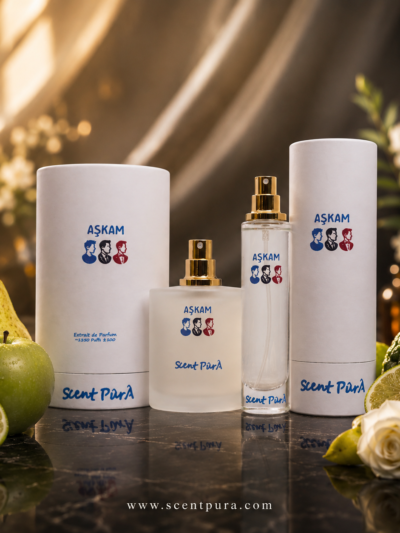
Aşkam
Fresh fruity floral fragrance with bergamot, pear, and green apple, blended with jasmine, rose
100 ml
40 ml
fromRs 2,699Rs 2,800
Choose size 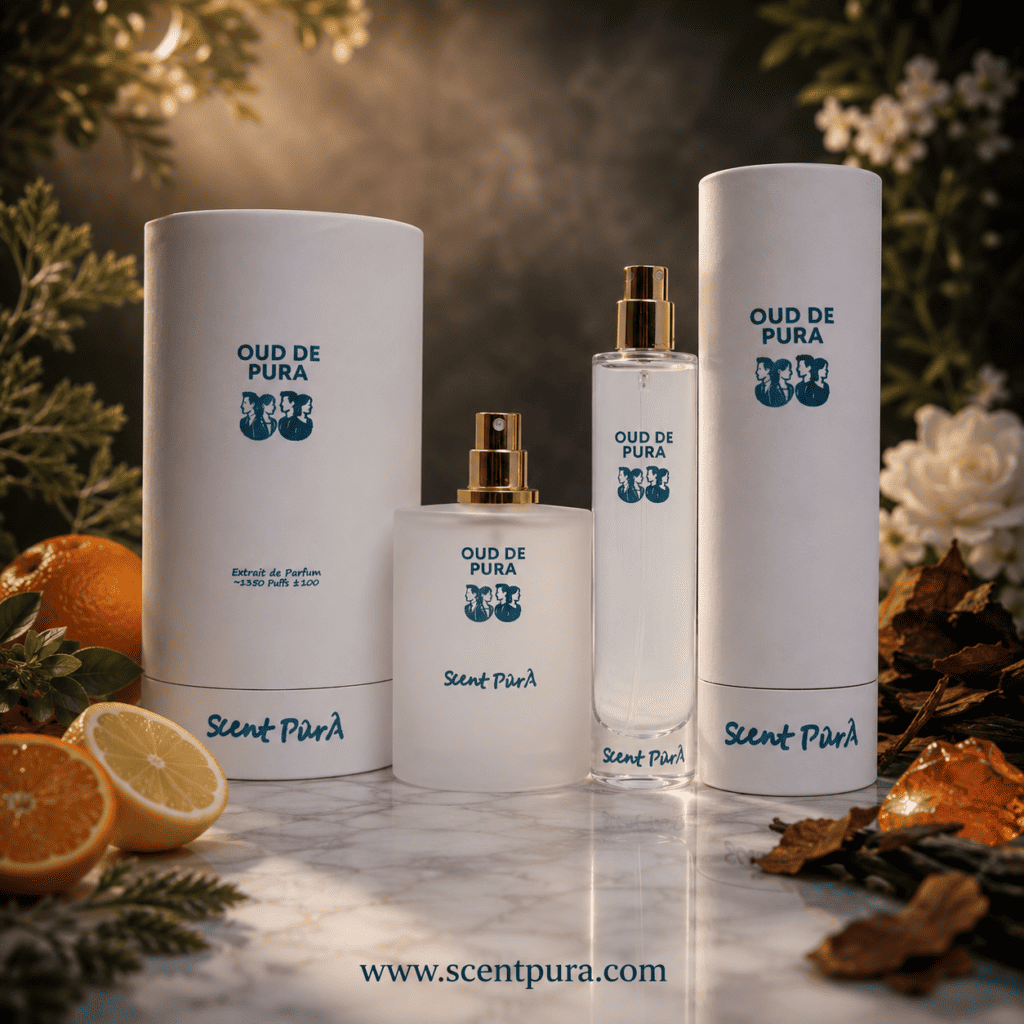
Search “extrait de parfum price in Pakistan” and you will find bottles from Rs 1,699 to Rs 25,000, all wearing the same French label. That is a huge gap for one word. So what is that word actually promising, and which part of the price is paying for it?
We should say up front: we sell perfume, and every one of our bottles is an extrait. You should read this knowing that. We have tried to write the guide we would want to read before buying, including the places where other brands do better than us.
Perfume is a blend of fragrance oil and alcohol. The label names the rough share of oil, using a few loose categories. The figures below are the ranges usually quoted in the trade. They are conventions, not laws, and no Pakistani regulator checks them:
Look at the extrait band. A 20% extrait and a 40% extrait share a label, but one has twice as much oil as the other. Almost no brand in Pakistan, us included, prints a third-party test of its concentration on the bottle. So “extrait” tells you which band the perfume claims to be in. It does not tell you where in that band it sits.
Three things follow from that:
Comparing bottle prices is misleading when bottles run from 15 ml to 100 ml, so we divided each price by its size. We checked every figure on the brand’s own website on 21 October 2026. Prices change, so follow the links for today’s figure.
| Perfume (brand) | Label | Size | Price | Per ml |
|---|---|---|---|---|
| Colish Extrait collection (e.g. Himalayan Cedar, Layal) | Extrait de parfum | 100 ml | Rs 25,000 | Rs 250 |
| J. Extrait range (e.g. Santal Noble, Legende de Oud) | Extrait de parfum | 100 ml | Rs 16,000 | Rs 160 |
| THE NOTE Osmanthus | Extrait de parfum | 15 ml | Rs 1,749 | Rs 117 |
| THE NOTE Osmanthus | Extrait de parfum | 50 ml | Rs 4,349 | Rs 87 |
| THE NOTE Vetiver Vanilla | Extrait de parfum | 50 ml | Rs 4,249 | Rs 85 |
| Scent Pûr Oud de Pura | Extrait de parfum (35–40%) | 40 ml | Rs 2,799 | Rs 70 |
| Scent Pûr Oud de Pura | Extrait de parfum (35–40%) | 100 ml | Rs 5,599 | Rs 56 |
| Scent Pûr Calmera | Extrait de parfum (35–40%) | 100 ml | Rs 4,399 | Rs 44 |
None of the other three brands states an oil percentage on the pages we checked. For context, Colish’s own EDPs on the same page cost Rs 7,800 to Rs 10,800 for 100 ml (Rs 78–108 per ml). That is more per ml than several extraits in this table. It shows again that the label is only one part of the price.
For the wider picture, including designer imports and copies, see our earlier guide to what perfume actually costs in Pakistan.
For most buyers here, yes, but for a different reason than you might expect. In 38°C heat, the alcohol and the lightest top notes leave your skin quickly whatever the label says. An EDT can feel faded by lunchtime. With more oil, more of the heart and base notes stay behind after the alcohol has gone. Those are the woods, musks, ambers and resins.
Two honest limits:
A 15 ml bottle at Rs 1,749 looks cheaper than a 100 ml bottle at Rs 4,399. Per ml, it costs well over twice as much. Small sizes are good for trying a scent and poor value for one you already know you love.
An extrait at 35–40% does not need ten sprays. Three or four on pulse points and clothing is usually enough. More than that can tire out the people near you, especially in a closed office or car. Spray onto skin that has just been moisturised, and let it dry rather than rubbing your wrists together. Rubbing warms the skin and speeds up the evaporation of the top notes you have just paid for.
A paper strip in a shop tells you about the first ten minutes. The base notes, which are what you pay extra for in an extrait, take hours to show. Wear a sample through a whole day, ideally a warm one, before you buy a full bottle.
Choosing a perfume for someone else is a gamble. A sampler lets them pick their own. Colish sells an Extrait Discovery Set for Rs 3,000. Our Build Your Own Tester Box is five perfumes of your choice for Rs 1,500.
Plainly: Scent Pûr makes extraits at 35–40% oil, in 40 ml and 100 ml bottles. On the day we checked, the perfumes named in this article cost Rs 4,399 to Rs 5,599 for 100 ml and Rs 2,199 to Rs 2,799 for 40 ml. That puts us near the bottom of the per-ml table above, and that is deliberate.
Where others win:
Our honest suggestion is to start with the tester box. Wear each scent for a full day, and only then buy the bottle that earned it.
It is French for “perfume extract”, the most concentrated common type of perfume. It usually has around 20–40% fragrance oil, against roughly 15–20% for an eau de parfum.
On 21 October 2026, local brands ranged from about Rs 44 to Rs 250 per ml. That means roughly Rs 4,399 to Rs 25,000 for a 100 ml bottle, and from Rs 1,699 for 15 ml. See the table above for details.
Usually, on the same skin and with a similar scent, because there is more oil left after the alcohol evaporates. But the notes matter as much as the concentration. A citrus extrait can fade before a woody EDP.
Not necessarily. Extraits often stay closer to the skin. They last longer but do not always project further. If you want projection, look for scents built on ambers, woods and spice.
Three or four is plenty for most people: neck, wrists and a spray on clothing. In a closed office, two may be enough.
Not automatically. A lot of a perfume’s price goes on shops, branding and packaging. Ask the brand for its oil percentage, and judge the scent on your own skin over a full day.
Extrait de parfum, blended in Pakistan. A tester in every box.
Fresh fruity floral fragrance with bergamot, pear, and green apple, blended with jasmine, rose
Herbal leather fragrance with bergamot, lavender and artemisia, tarragon
Elegant floral woody — lavender, bergamot, mandarin, rosewood
Soft floral musk perfume with notes of violet, jasmine, and vanilla